
· Three of D. H. Lawrence’s most important themes are prominent in “The Rocking-Horse Winner”: the corroding effects of acquisitive behavior on English society, the Words | 4 Pages. Symbolism and Religion in “The Rocking-Horse Winner” In D. H. Lawrence’s “The Rocking-Horse Winner,” Lawrence utilized symbols to reveal the natural affection between mother and son, and hints of religion to expose the corruption of greed on a family. Symbols riddle William De Witt Snodgrass’ essay, “A Rocking-Horse: The Symbol, the · Analysis for “The Rocking-Horse Winner” D. H. Lawrence’s “The Rocking-Horse Winner” is an on-the-edge short story that teaches an important lesson about the dangers and consequences from pursuing too much wealth and possessions. Purposely narrated in an omniscient point of view, this short story interweaves situational and imagery to illustrate that
The Rocking-Horse Winner Essays | GradeSaver
This can be understood as a metaphor for the desire for wealth in his mother being so loud that it echoes throughout the entire home. In this way a Freudian psychoanalytic reading can be applied, specifically with regard to the Oedipus complex, the rocking horse winner essay. The Oedipus Complex is first introduced by Freud within his text The Interpretation of Dreams, and is said to occur during the latency stage of psychosexual development which spans age six through to puberty.
As the narrative progresses, the oedipal complex within Paul grows more evident. Now take me! This complex, according to Freud, refers to the fear within the child that they face castration at the hands of the father in response to learning of their desires for the opposing parent, the rocking horse winner essay, in order to prevent the child from pursuing their sexual interest.
In this context, then, Paul is desperate to acquire the luck that his father does not have in order to win the affection of the mother whilst he is out of the picture. This attitude is made even more explicit within the end of the narrative, which sees Paul die after becoming overwhelmed at the news of winning eighty thousand pounds. Lawrence: A Digital Pilgrimage. You can submit artefacts here. James is a Nottingham based writer. His previous digital works in collaboration with Paul Fillingham include Dawn of the Unread, the Sillitoe Trail, Being Arthur.
He is a former chair of the Nottingham Writers' Studio and a former board member of Nottingham: UNESCO City of Literature. He was the literature editor of Leftlion magazine for 13 years. He loves books, the rocking horse winner essay. uk View all posts by James Walker.
While reading different aspects of D. Lawrence I came across the visual essay ´´The Psychoanalytic Implications of D H Lawrence´s The Rocking Horse Winner´, where the writer of the essay applies ´Freudian Psychoanalytic reading´, specifically with regard to the Oedipus complex. No doubt, there are certain psychoanalytical aspects in the short story if we go through the text and characterisation. But I strongly disagree the implication of ´Oedipus complex. As the text explains, ´There was a woman who was beautiful, who started with all the advantages, yet she had no luck… Only she herself knew that at the centre of her heart was a hard little place that could not feel love, no, not for anybody.
She adores her children. There is nothing or any kind of desire to find mother´s love and go against the rocking horse winner essay. On the contrary the story states, ´Although they lived in style, they felt always an anxiety in the house, the rocking horse winner essay.
There was never enough money. There is nothing to do with primal instinct to satisfy sexual or sensual shortage. I wonder how the financial pressure and anxiety have been moulded into the sexual interpretation?
It is not that the child wants some sensual pleasure or ´sexual affection´ from his mother, he wants to decrease the financial burden he feels upon his mother, the rocking horse winner essay, here what is extraordinary is the child´s obsession. It is natural that we can´t see our parents, siblings and loved ones in suffering whatever that may be.
This natural instinct can´t be shifted towards pleasure gaining desire or like that. The next two paragraphs are more explicit regarding child´s obsession of the shortage of money, there are echoes in the house, there is whispering everywhere, even the rocking horse hears that whispering.
Whispering and echoes of lack of money, ´And so the house came to be haunted by the unspoken phrase: There must be more money! There must be more money! The children could hear it all the time though nobody said it aloud. In this dialogue the rocking horse winner essay her boy she blames that his father has no the rocking horse winner essay, and she further explains to him that luck causes to have money.
An exploration begins within the mind of the child to have that luck that causes money. Absorbed, taking no heed of other people, he went about with a sort of stealth, seeking inwardly for luck.
He wants to help his mother to come out of that financial pressure, they have been obsessed with, even the entire house has drowned in it. He wants to bring that luck back. The child has developed a kind of disorder which can be described as Obsessive-compulsive disorder, where his obsession leads to anxiety and his brain is actively engaged in a kind of activity to bring out luck from anywhere.
At the end of the story, when Paul´s mother finds him ´madly surging´ on the rocking horse, she is shocked and terrified by the condition of the boy: ´But he was unconscious, and unconscious he remained, with some brain-fever. He talked and tossed, and his mother sat stonily by his side. He tells his mother that he is lucky, he can win. And here is the mastery of D. Lawrence, the boy dies, losing himself and winning the battle of luck.
I disagree that there is any kind of hint of Oedipus complex or sexual connotation anywhere in the story, the story itself carries a burden of unusual anxiety and pressure, the rocking horse winner essay, which, not only the characters feel, but also the reader of the story.
H Lawrence does not allow a simple reading and a happy ending. There is nothing pleasurable, not only in the relations of the family but also in the environment of the house. Like Like. You are commenting using your WordPress.
com account. You are commenting using your Google account. You are commenting using your Twitter account. You are commenting using your Facebook account. Notify me of new comments via email. Notify me of new posts via email. Skip to content July 8, July 22, James Walker NTU PLacementsPhoto Essayshort storiesVideo. Share this, or I will rage!!! Share Click to share on Twitter Opens in the rocking horse winner essay window Click to share on Facebook Opens in new window Click to share on LinkedIn The rocking horse winner essay in new window Click to share on Tumblr Opens in new window Click to share on Pinterest Opens in new window Click to share on WhatsApp Opens in new window.
Like this: Like Loading Published by James Walker. Leave a Reply Cancel reply Enter your comment here Fill in your details below or click an icon to log in:.
Email required Address never made public. Name required. Student Essay: Lawrence as an eco-critical writer. Student Essay: D. Lawrence — Pornographic pervert or libertarian? Email Required Name Required Website. By continuing to use this website, you agree to their use. To find out more, including the rocking horse winner essay to control cookies, see here: Cookie Policy.
The Rocking-Horse Winner by Shmoop
, time: 3:02The Rocking-Horse Winner - Words | Essay Example
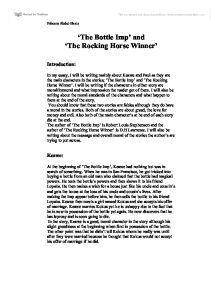
The Rocking Horse Winner Essay. Words3 Pages. The Rocking Horse Winner. When a person is lucky, it does not have to mean that they are fortunate with money. Luck is the chance for things to go the way you want them to go with out having any control over the situation. In The Rocking Horse Winner, Hester, the mother seems to believe that luck is · Three of D. H. Lawrence’s most important themes are prominent in “The Rocking-Horse Winner”: the corroding effects of acquisitive behavior on English society, the · Analysis for “The Rocking-Horse Winner” D. H. Lawrence’s “The Rocking-Horse Winner” is an on-the-edge short story that teaches an important lesson about the dangers and consequences from pursuing too much wealth and possessions. Purposely narrated in an omniscient point of view, this short story interweaves situational and imagery to illustrate that

No comments:
Post a Comment